A lot of people don’t start thinking about the estate tax until they are over the current $30M limit for 2026.
The problem with this is that by waiting so late their beneficiaries will end up losing tens of millions of dollars to the estate tax that they didn’t have to if they would have just started their planning earlier.
In our last post we spoke about how Peter Thiel contributed $2,000 to a Roth IRA that turned into a $5 billion investment that was free from income tax, but subject to the estate tax.
Ultimately since the Roth IRA is in Thiel’s estate and he’s a California resident, he will end up paying almost as much in estate taxes as he would have if he had a single $5 billion realized gain in his investments by not using the Roth IRA.
This is a bit of a simplified example however because the reality is that a major part of the reason why Thiel was able to accumulate $5 billion is because he had realized gains in a Roth IRA along the way that he didn’t have to pay taxes on. So he was able to compound his wealth to a greater extent than he would have if he had to pay taxes along the way.
In other words, doubling your money on $2.5 billion to get to $5 billion is not the same as paying 40% taxes on $2.5 billion and doubling what’s left over.
There is embedded value to tax-free compounding here that comes as a result of the Roth IRA because he had realized gains from his investments in the interim.
But for the sake of understanding the income tax versus estate tax play, let’s presume Thiel had amassed $5 billion in unrealized gains in a taxable account.
Should he sell the position and realize the gains even if he has to pay income taxes now and then estate taxes later?
Should he keep the position so his beneficiaries benefit from step-up in basis and don’t have to pay income taxes and just pay the estate taxes?
How do either of these decisions compare to his decision to purchase the shares within a Roth IRA?
What if instead of purchasing the shares from within a Roth IRA he would have purchased it from within an estate planning vehicle instead?
The table below summarizes the options below and we’ll be going over them in this article.
Income and Estate Tax Consequences Associated with Different Strategies and Vehicles
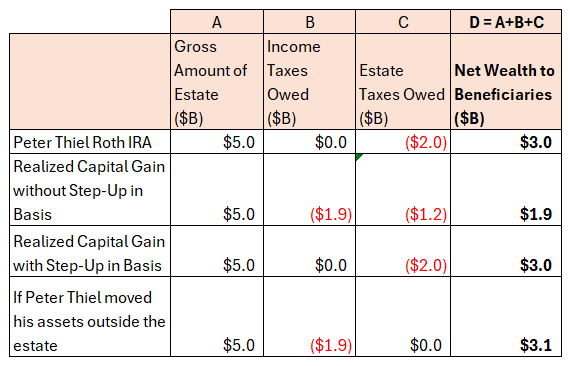
But before we do that, we first have to understand what the estate tax is and step-up in basis.
What is the Estate Tax?
The estate tax is a tax that the federal government (and some states) charge your estate before your beneficiaries inherit the assets after you pass away.
As of 2026, if you’re married your first $30M is protected from the estate tax. But everything above that is taxed at 40%.
So let’s look at the Peter Thiel example again.
He has $5 billion in a tax-free Roth IRA. The first $30M of that is protected from the estate tax. But $30M is less than 1% of the total $5B. That means more than 99% will be subject to the 40% estate tax.
So if he were to die today, his heirs would only get $3 billion of this $5 billion he accumulated.
Understanding How the Estate Tax is Calculated

Now because Thiel’s assets are in a Roth IRA they are free from income taxes.
So even though his beneficiaries lost nearly $2 billion due to estate taxes, they will never have to pay income taxes on the assets when they sell them.
However, if he was a buy and hold investor he wouldn’t need a Roth IRA for his beneficiaries to avoid paying income taxes.
His beneficiaries would inherit everything tax-free through a provision known as step-up in basis which I’ve covered before.
Step-up in basis allows beneficiaries to inherit assets and have the basis “stepped-up” from what the original buyer purchased it at to the current market value of the asset.
So that way when your beneficiaries inherit the assets they don’t pay income taxes on the sale.
The table below shows the value of having a realized gain when you have the basis stepped up to the market value versus a normal realized gain where the taxable gain is the difference between the sale price and the purchase price (i.e. the cost basis).
The Benefit of Having A Step-Up in Basis with a Realized Gain
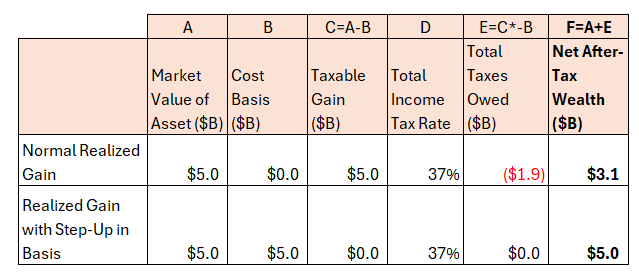
In the above table we see that with step-up in basis the Cost Basis (Column B) is stepped-up to the Market Value of the Asset (Column A) which then results in a $0 Taxable Gain (Column C) which is in sharp contrast to the $5 billion taxable gain without step-up in basis.
Now let’s take our Peter Thiel example and incorporate the estate tax component of it.
Assume Peter Thiel purchased private shares in a company within a taxable account for $2,000 and those shares were worth $5 billion just before his death.
In other words, all the gains here are unrealized gains that have not been taxed yet.
If he were to sell them before his death, he would pay income taxes on the gain AND his estate would pay estate taxes leaving his beneficiaries with only $1.9 billion of the $5 billion he had at his death.
However, if he passes away his estate would still pay estate taxes, but when his beneficiaries inherit it the basis of the assets would be “stepped up” from $2,000 to $5 billion. That way when his beneficiaries sold the assets there would be no taxable gain because the value of the assets is equal to the basis.
In this way his beneficiaries are paying the estate tax, but saving on income taxes on the sale.
How Step-Up in Basis Mitigates the Estate Tax
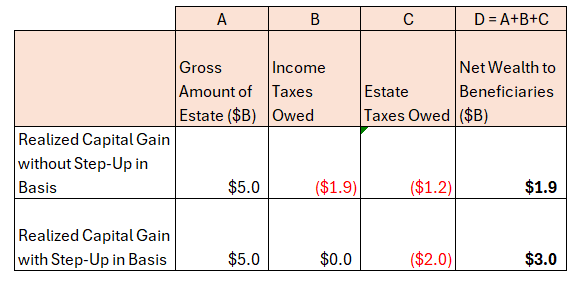
The key point to note here is that if you’re a wealthy buy and hold investor, then the loss of estate taxes is somewhat mitigated by the savings on income taxes due to step-up in basis.
And if you’re in a state with high income taxes, then what you lose in estate taxes is almost entirely made up by the savings in income taxes that your beneficiaries get.
In other words, the upside of paying estate taxes for a buy and hold investor is that your beneficiaries save on income taxes.
Which brings us to one of the key problems with estate planning and moving assets outside the estate.
Estate planning in the United States allows you to move assets outside of your estate and into an estate planning vehicle where future appreciation of those assets will be free from the estate tax.
This is similar to the Roth IRA strategy where moving assets into a Roth allows the future appreciation to be free from income tax.
Estate planning is essentially applying this same strategy to the estate tax instead of income tax.
However, there is one key catch here with estate planning and moving assets outside of the estate and into these vehicles.
When you move assets outside the estate, then you lose step-up in basis.
So there is a catch to estate planning here if you haven’t figured it out yet.
Keep assets in the estate and you pay the estate tax but you keep step-up in basis.
Move assets outside the estate and you save on the estate tax, but lose step-up in basis so when your beneficiaries inherit it and sell them they would pay income taxes on the gains.
Should You Pay Higher Estate Taxes or Higher Income Taxes?
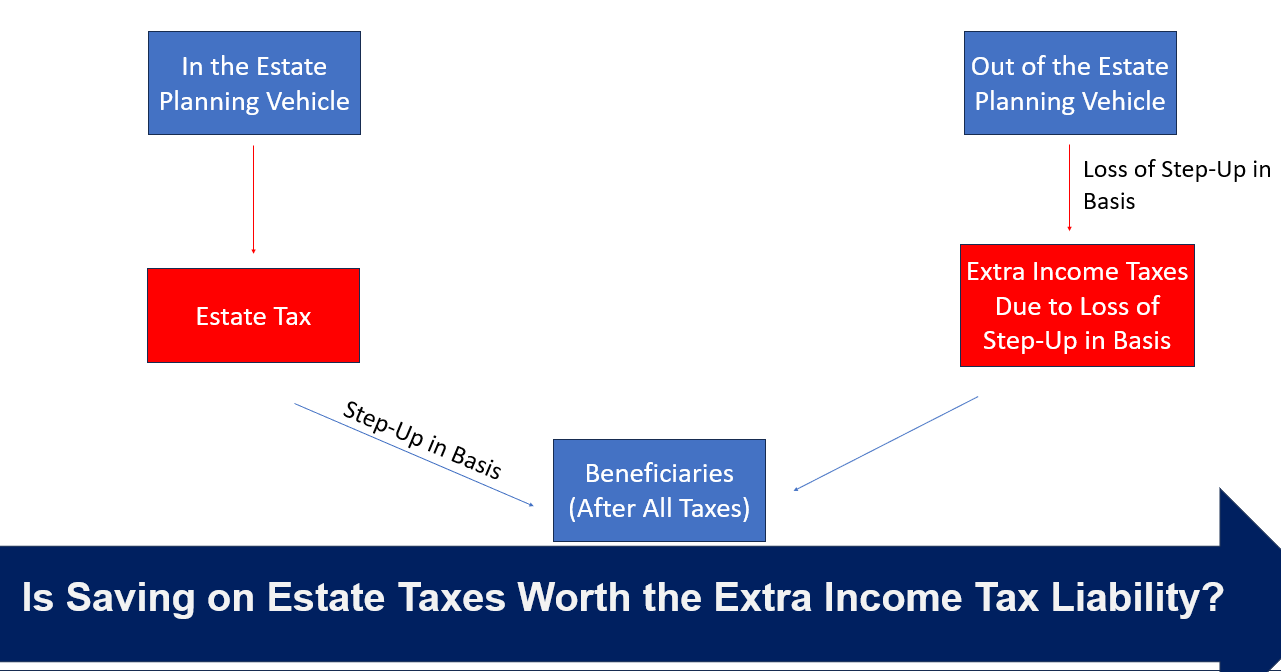
This is a problem if you live in states like California where the total tax-rate on the gains is over 37% which is just shy of the 40% estate tax rate.
Total Capital Gains Tax Rates in States Like California are Nearly as High as the Estate Tax Rate

When that’s the case, how do I maximize the use of my estate planning vehicle?
The first part of that answer is to keep assets in the estate that will have a lot of unrealized gains when you pass away so that they get step-up in basis which will at least partially offset any losses due to the estate tax.
The second part of that answer is to move assets outside of the estate that will be heavily taxed from an income tax basis regardless of whether they are in the estate or out of the estate.
Moving tax-inefficient assets outside of the estate
As we alluded to previously, step-up in basis only applies to assets that are tax-efficient.
In other words, it is tax-efficient because you can defer the tax on these assets indefinitely until you sell the assets (or permanently if you defer long enough so that your beneficiaries inherit it tax-free through step-up in basis).
But this doesn’t apply to all assets:
Some assets are taxed every year and you can’t defer the taxation (think private credit, bonds, and other fixed income securities).
Other assets face taxation because the policyowner chooses to sell the asset and thereby turns and unrealized gain into a realized gain (think of a business owner choosing to sell their business instead of passing it on to their beneficiaries).
Let’s look at point 1 and we’ll address point 2 in the next section.
Consider the following example.
Jason and Mary are California residents worth $30M with a $30M cost basis and a 30 year life expectancy. They want to invest in private credit which makes 8% a year but is taxed at 50% every year.
Should they keep these assets in their estate or move them out of the estate?
The table below helps us answer the question.
Keeping Tax-Inefficient Assets in the Estate Versus Moving Them Out

In both cases the gross amount of assets is the same at about $164 million. Also the amount of income taxes being paid is the same here since in both cases the assets are taxed yearly (so there are no unrealized gains to be stepped up). So in both cases the total income taxes paid over 30 years are $67 million.
The only difference then is that if Jason and Mary move the assets outside of the estate, they save $27M in estate taxes.
And this is how to think about estate taxes in a quick little blurb:
1) If I’m going to have a large unrealized gain when I pass away, I should keep it in my estate to benefit from step-up in basis.
2) If I’m going to pay income tax regardless and can’t avoid it (the way I can with step-up in basis) then I might as well move it out of the estate to avoid the estate tax.
3) If I’m going to have a large realized gain, it’s better to plan this early so that all of this realized gain is out of the estate (as well as any future gains).
We’ll cover point number 3 in the next section.
The Benefits of Early Estate Planning with Large Realized Gains
A lot of the benefits around estate planning share similarities with that of Thiel’s Roth IRA planning.
Namely, that it requires proactive planning to get the most value out of it and in order to save on one form of taxation you end up exposing yourself to another---unless you proactively plan for it.
What you’re essentially doing in both cases is “freezing” the tax liability today so that the future growth can be tax-free.
The difference is that with the Roth IRA you are freezing the income tax liability but with estate planning you are freezing the estate tax liability.
Let’s take a modified version of this Peter Thiel example, but apply it to estate planning.
Let’s assume a client had a private business that she thought was going to be worth $5 billion in the future but currently it’s only worth $2,000.
She has to choose between the following two estate planning options:
1) Move the shares of a private company outside the estate right now when they are only worth $2,000.
2) Wait until the shares are worth $3 billion and then move the assets outside the estate
We can see the effects of doing that in the table below.
Moving Assets Out of the Estate Prior to Appreciation versus After
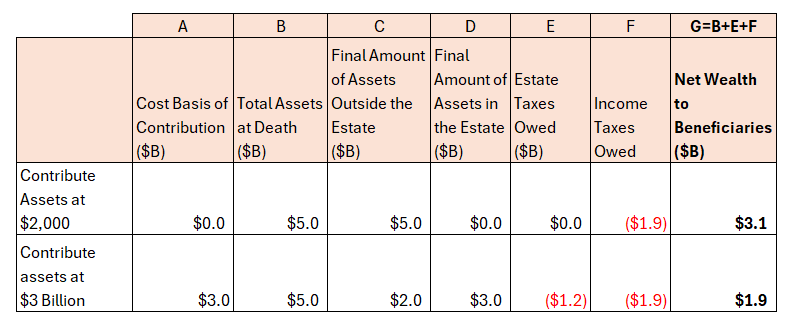
As we can see in the table above, contributing the shares of the company when the company is only worth $2,000 allows the full gain from $2,000 to $5 billion to be out of the estate. Yes her beneficiaries will still pay income taxes on the realized capital gain (Column F) when they sell the company because they didn’t get step-up in basis, but they saved almost $2 billion in estate taxes by moving it out of the estate when it was only worth $2,000.
On the other side, by moving the asset out of the estate when it’s worth $3 billion then only the future growth is outside of the estate. So the growth from $3 billion to $5 billion is out of the estate. However, that first $3 billion is in the estate and subject to the estate tax because the client waited too long to move the assets outside the estate.
So by choosing to wait until the asset was worth $3 billion, the client ended up costing herself $1.2 billion in estate taxes (Column E) that she didn’t have to pay if she would have planned this earlier.
It's this same logic behind why Peter Thiel moved his Paypal shares into a Roth IRA when they were only worth $2,000 instead of waiting until they were worth more. He wanted the full gain to be in an income tax free vehicle.
Analogously if you want to move assets outside the estate, it’s better to do so when they are only worth $2,000 so that the full gain can be free of the estate tax.
Unfortunately that’s not what most people do.
They wait until AFTER they have a liquidity event, to worry about their financial planning and wealth management issues.
But if they were to be proactive about both before, there is a wealth of value they can add for both themselves and beneficiaries.
Webinar next week, 10/1 on Estate Planning and PPLI
So if you’re a little bit more proactive with your financial planning you might be reading this article and thinking:
“There has to be a way for me to save on both income taxes AND estate taxes”
And there is. It involves stacking estate planning opportunities and using an estate planning vehicle along with an insurance product known as private placement life insurance (PPLI).
What it essentially allows you to do is to take Peter Thiel’s Roth IRA strategy and have that be out of the estate so that it is free from both income taxes and estate taxes.
As you can imagine the gain from doing this is tremendous (as evidenced in the chart below).
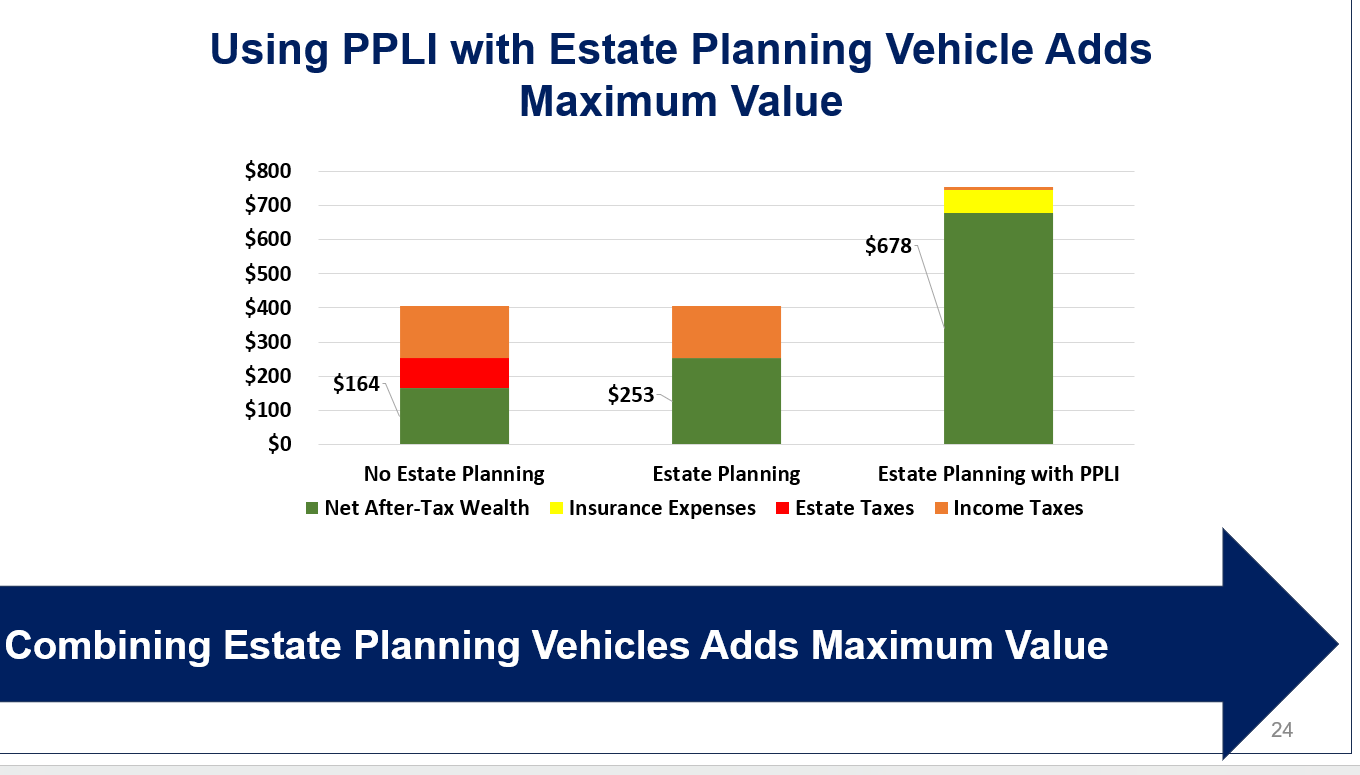
I’ll be covering this in my next post, but I’m also doing a webinar with Mani Mahadevan the founder of Valur, an estate planning firm on how to think about and implement this. The webinar will be online on Wednesday 10/1 at 11 am PST/2 PM EST.
You can register through the link below:
https://streamyard.com/watch/wDU8xAFYPR9g

Link for October 1st Webinar: https://streamyard.com/watch/wDU8xAFYPR9g
About the Author
Rajiv Rebello is the Principal and Chief Actuary of Colva Insurance Services and Guaranteed Annuity Experts. He helps HNW clients implement better after-tax, risk-adjusted wealth and estate solutions through the use of strategic planning and life insurance and annuity vehicles. He can be reached at rajiv.rebello@colvaservices.com.
You can also book a call directly with him here: